Northshore fencing company explains stepped and racked fencing, pine and cedar options, drainage concerns, DIY slope measurements, and fall maintenance.
PONCHATOULA, LA, UNITED STATES, October 19, 2026 /EINPresswire.com/ — # Tony’s Fencing & Iron Works Shares Fall Fence Installation Recommendations for Sloped Louisiana Properties
**Southeast Louisiana fencing company provides homeowners with practical information on stepped and racked fences, wood materials, drainage, slope measurements, and seasonal maintenance.**
Tony’s Fencing & Iron Works is sharing expanded educational recommendations to help Southeast Louisiana homeowners understand the challenges of installing fences on sloped and uneven properties. The information addresses installation methods, soil conditions, drainage, material selection, and preparation steps homeowners can complete before construction.
Across St. Tammany and Tangipahoa parishes, properties in Covington, Mandeville, Madisonville, Slidell, Hammond, and Ponchatoula may contain drainage swales, uneven elevations, wooded sections, and low-lying ground. These conditions influence how privacy fences are designed and installed.
**Understanding Stepped and Racked Fence Installation**
Two commonly used methods accommodate elevation changes.
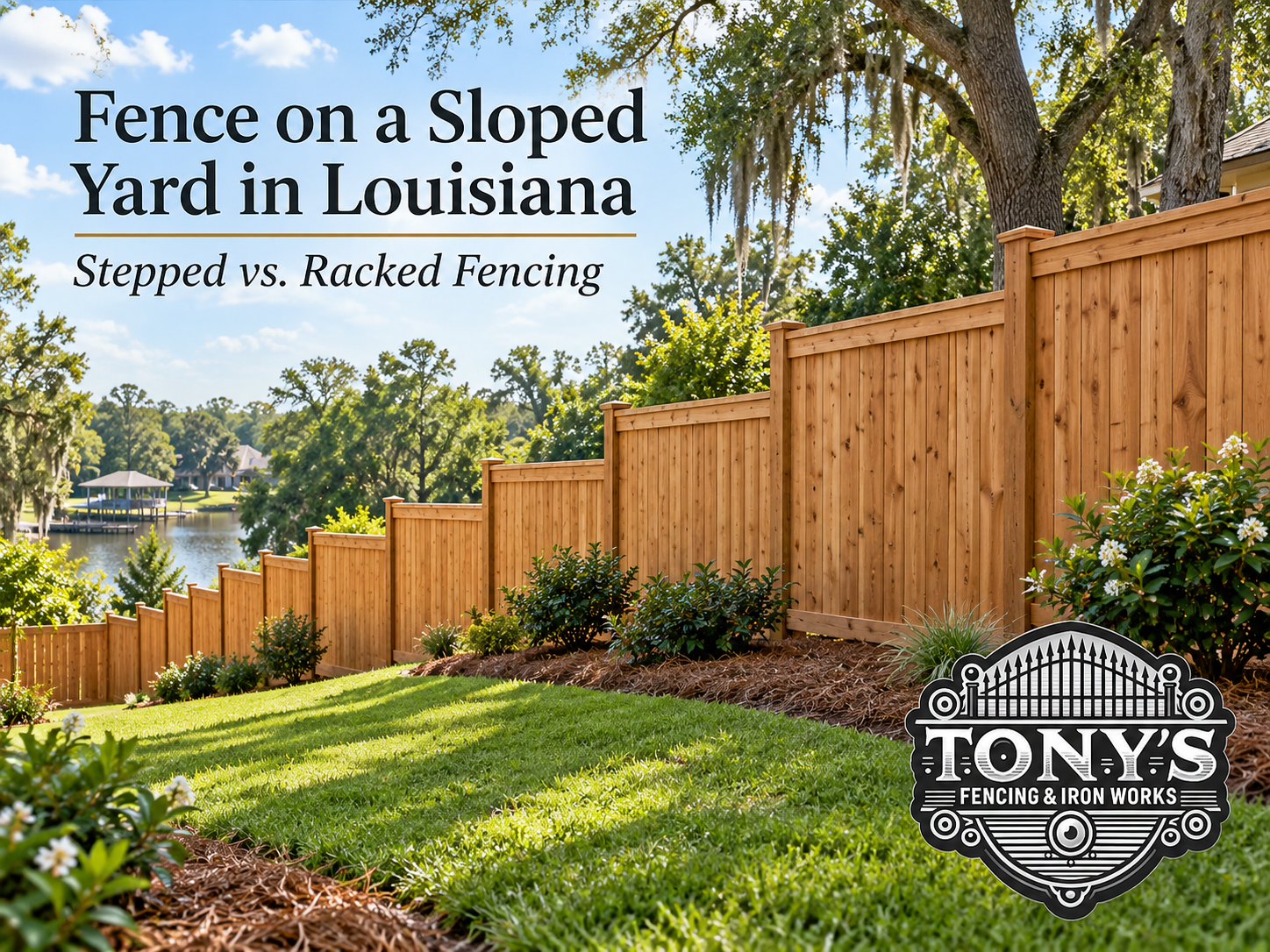
Stepped fencing consists of level sections installed at gradually changing heights. The finished fence resembles a staircase. This approach can accommodate pronounced slopes, particularly when installing traditional wood privacy fencing. However, stepped sections may create triangular openings beneath the fence.
Racked fencing follows the natural ground contour. Instead of installing each section horizontally, compatible panels gradually rise or fall with the terrain. This approach can reduce certain ground-level gaps and create a more continuous appearance.
Not all manufactured panels support racking. Therefore, homeowners should verify product limitations before purchasing materials.
**Selecting Fence Materials for Louisiana Conditions**
Pressure-treated pine and cedar are common materials for residential privacy fencing.
Pressure-treated pine generally offers a lower initial material cost. Proper treatment, installation, and maintenance help protect the wood against conditions associated with outdoor exposure.
Cedar contains naturally occurring compounds that provide some resistance to decay and insects. Nevertheless, cedar requires maintenance and can deteriorate when repeatedly exposed to standing moisture.
Custom-built wood sections allow installers to accommodate uneven elevations by adjusting individual boards and layouts.
Chain link, aluminum, vinyl, and ornamental iron systems may also accommodate sloping properties. Their suitability depends on the design, approved slope limits, and installation requirements.
**Why Drainage and Soil Conditions Matter**
Louisiana’s rainfall and humid environment make water movement important during fence planning.
An improperly placed fence can interfere with an existing drainage path. Additionally, water flowing downhill may remove soil around posts or expose underground components.
Homeowners should identify areas where rainfall collects, where soil washes away, and where existing fences show signs of leaning.
Drainage swales and ditches should not be filled or obstructed without evaluating applicable local requirements.
Post-hole depth and construction methods depend on soil conditions, structural requirements, fence height, and wind exposure. A sloped property does not automatically require deeper posts, but unstable soil may require additional consideration.
**DIY Tips: Measuring a Sloped Yard Before Installation**
Homeowners can perform preliminary measurements using stakes, string, a line level, and a tape measure.
First, place stakes along the proposed fence line. Next, stretch a string between them and adjust it until level.
Then, measure the horizontal distance between the stakes. Record the difference between the level string and the ground at each end.
To determine the percentage of slope, divide the elevation change by the horizontal distance and multiply by 100.
For example, a 12-inch change across a 120-inch horizontal distance produces a 10% slope.
This measurement helps describe the property’s terrain, although it does not independently determine which fence system is suitable.
For longer fence lines, homeowners should repeat measurements at shorter intervals to identify abrupt elevation changes.
**Additional DIY Preparation and Maintenance Tips**
Homeowners can also take several practical steps before scheduling installation.
1. Photograph the yard after heavy rainfall to document water movement and standing water.
2. Identify trees, roots, utility equipment, retaining walls, and other obstacles near the proposed fence line.
3. Measure the approximate distance between planned corners and gates.
4. Examine existing wood fencing for loose boards, discoloration, leaning posts, and deterioration near the ground.
5. Check whether pets could escape through openings beneath stepped fence sections.
6. Remove light vegetation that obstructs visibility while avoiding digging or disturbing established drainage features.
7. Confirm property boundaries and review applicable easements before construction.
Underground utility marking should be requested through Louisiana 811 before excavation. Private utility lines may require separate locating arrangements.
**Frequently Asked Questions About Sloped Yard Fencing**
**Can a privacy fence be installed without leveling the entire yard?**
Yes. Stepped and racked installation methods can accommodate existing ground elevations. Extensive grading is not always necessary and may alter drainage patterns.
**Which method is better for steep slopes?**
Stepped fencing is frequently suitable for pronounced changes in elevation. However, the preferred method depends on fence materials, panel construction, and site conditions.
**How can homeowners reduce openings beneath a sloped fence?**
Custom-cut pickets, carefully positioned sections, and appropriate ground-clearance planning may reduce openings. Drainage and moisture exposure must also be considered.
**Does cedar perform better than pine in Louisiana?**
Cedar offers natural decay resistance, while pressure-treated pine provides a cost-conscious alternative. Actual performance depends on treatment, installation quality, maintenance, and environmental exposure.
**Can fencing interfere with stormwater runoff?**
Yes. Fence construction, accumulated debris, or changes to existing ground elevations may obstruct drainage. Homeowners should preserve necessary water pathways and obtain approval where required.
**Are permits required for sloped fence installation?**
Permit and setback requirements vary by municipality, parish, property location, and fence design. Homeowners should confirm applicable rules with their local permitting authority.
**Can a gate be installed on sloping ground?**
Yes. However, gate placement requires additional consideration because a swinging gate must maintain sufficient clearance throughout its opening path.
**Does sloped fencing cost more than installation on level ground?**
It can. Custom sections, additional layout work, difficult access, and unusual soil conditions may increase installation requirements.
**When should an existing fence be inspected?**
Homeowners should inspect fencing periodically and after significant storms. Particular attention should be given to loose posts, changing ground levels, damaged connections, and areas experiencing erosion.
**Fall Preparation for Southeast Louisiana Homeowners**
October provides an opportunity to review property conditions following summer rainfall and prepare for future fence improvements.
Homeowners can document drainage problems, compare materials, identify damaged fence components, and evaluate whether a proposed layout will accommodate changing elevations.
Additional information is available in Tony’s Fencing & Iron Works’ [blog post on fence installation for sloped Louisiana yards](https://tonysfencingandiron.com/fence-on-sloped-yard-louisiana/).
**About Tony’s Fencing & Iron Works**
Tony’s Fencing & Iron Works provides residential and commercial fencing services across Southeast Louisiana. With more than 30 years of industry experience, the company offers pine and cedar wood fencing, vinyl, chain link, ornamental iron, custom gates, and related fencing services.
The company serves Covington, Mandeville, Madisonville, Slidell, Hammond, Ponchatoula, and surrounding communities.
**Media Contact**
Tony’s Fencing & Iron Works
Ponchatoula, Louisiana
Phone: (985) 703-0595
Website: https://tonysfencingandiron.com/
Gwen M.
Designs For You
Visit us on social media:
Facebook
Legal Disclaimer:
EIN Presswire provides this news content “as is” without warranty of any kind. We do not accept any responsibility or liability
for the accuracy, content, images, videos, licenses, completeness, legality, or reliability of the information contained in this
article. If you have any complaints or copyright issues related to this article, kindly contact the author above.

Media gallery