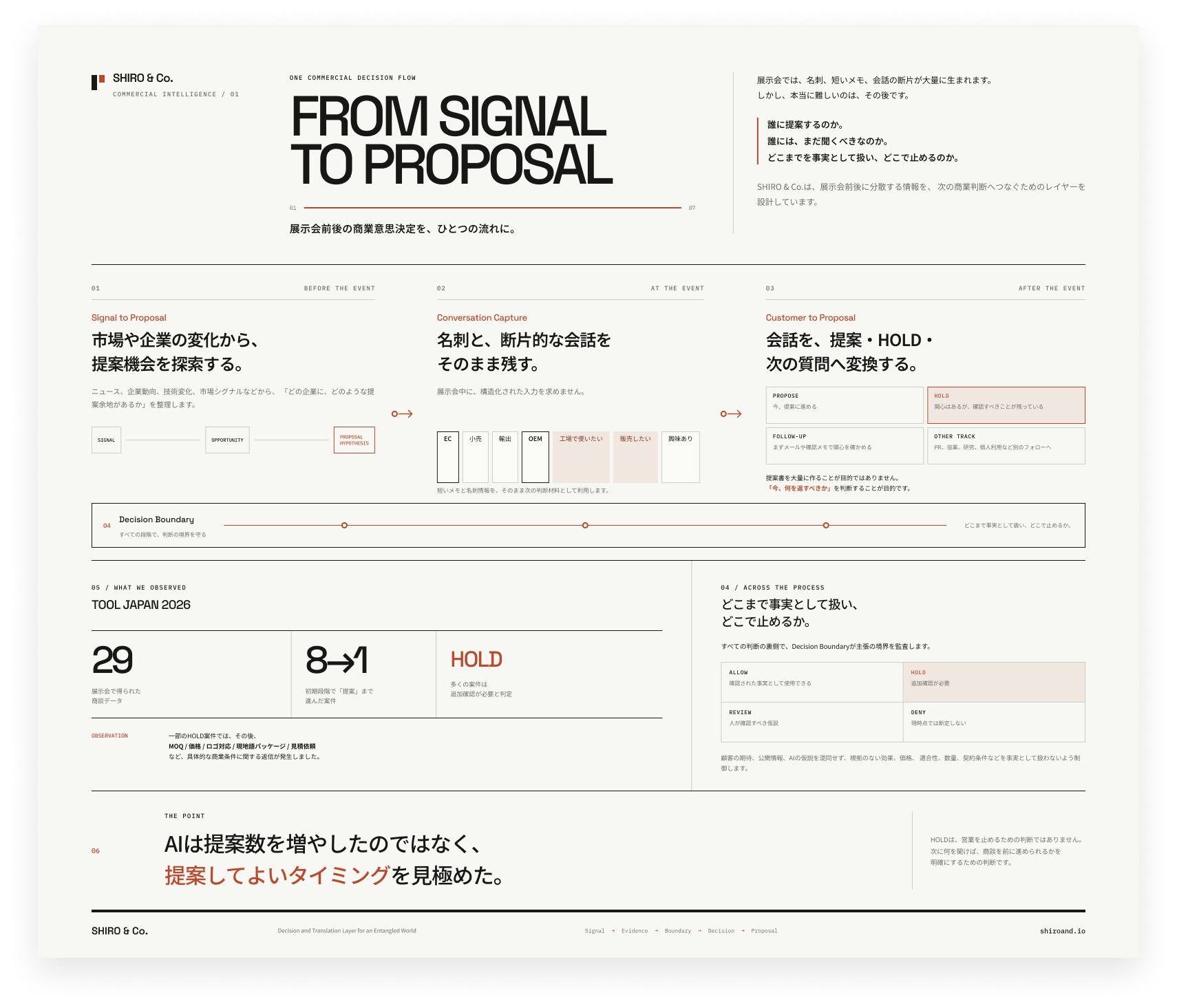
At TOOL JAPAN 2026, humans identified 8 proposal candidates from 29 cases. After evidence review, only 1 was ready for an immediate proposal.
Author: Kosuke Shirako, Founder and CEO, SHIRO & Co.”
TOKYO, OTA, JAPAN, October 13, 2026 /EINPresswire.com/ — At TOOL JAPAN 2026, human reviewers initially identified 8 proposal candidates from 29 business conversations. After evidence-based review through Customer to Proposal, only 1 was ready for an immediate proposal.
SHIRO & Co. has completed a real-world proof of concept of Customer to Proposal, an AI-assisted decision system designed to help B2B sales teams determine not only what to propose, but when there is not yet enough evidence to make a proposal.
The system was tested using business conversations captured during TOOL JAPAN 2026, where short notes, business cards and publicly available company information were analyzed after customer interactions.
The test covered 29 company-level sales cases.
In an initial human review, the cases were classified as:
8 Proposal
12 Strong Hold
8 Weak Hold
1 Do Not Propose
When the same cases were processed through Customer to Proposal, however, only one case was considered sufficiently grounded to proceed directly to an initial proposal.
The result was not that AI generated more proposals.
It generated fewer.
“Generating a proposal is becoming easy. The harder question is whether the available evidence is sufficient to send that proposal to a customer,” said Kosuke Shirako, Founder and CEO of SHIRO & Co. “In this test, human judgment initially identified eight proposal candidates. After separating evidence from assumptions, only one was ready to proceed immediately.”
From Conversation to Evidence
Trade-show conversations are rarely structured datasets.
A salesperson may leave an interaction with only a business card and several words of context such as “EC,” “Retail,” “Export,” “OEM,” “Interested,” or “Want to sell.”
Such signals may indicate commercial potential, but they do not necessarily establish purchasing intent, volume, timing, territory, pricing requirements or distribution conditions.
Customer to Proposal separates information into four categories:
CUSTOMER STATED — what the customer explicitly said.
PUBLIC SOURCE — information verified through company websites or other public sources.
PROPOSAL HYPOTHESIS — a possible commercial direction inferred from available evidence.
VERIFY — information that remains unknown and should be confirmed before proceeding.
The system does not convert the existence of a distribution network into an assumed intention to distribute a particular product. It does not convert interest into purchase intent, and it does not invent quantities, budgets or commercial conditions that have not been discussed.
HOLD Is Not a Rejection
A key finding from the test was that a HOLD decision did not necessarily mean that an opportunity should be abandoned.
Instead, HOLD identified what information was still needed.
In several cases, follow-up materials were sent after the initial assessment. Customers then responded with more specific commercial questions, including:
minimum order quantities
pricing
logo customization
English and local-language packaging
recommended battery specifications
quotations for potential distribution
In these cases, opportunities initially lacking enough evidence to support a proposal began moving toward a more concrete commercial stage after the missing information was surfaced.
SHIRO & Co. describes this as a transition from:
HOLD → Additional Evidence → Reassessment → Proposal
rather than treating HOLD as the end of the sales process.
The Decision Boundary Behind Customer to Proposal
Customer to Proposal incorporates SHIRO & Co.’s broader Decision Boundary architecture.
The principle is that a generated recommendation and permission to act on that recommendation are separate decisions.
Evidence is evaluated through boundaries such as:
ALLOW — sufficient evidence exists to proceed.
HOLD — additional information or human validation is required.
DENY — the claim or action should not proceed under the current evidence.
An AI model may be capable of writing a convincing proposal.
That does not mean the organization has enough evidence to send it.
The test was not designed to demonstrate that AI judgment is more accurate than human judgment. Instead, it examined what happens when sales opportunities are subjected to an explicit evidence boundary.
The most visible result was the change from:
Human initial assessment: 8 proposal candidates
to
Customer to Proposal: 1 immediately proposal-ready case
The remaining opportunities did not disappear.
They were converted into questions.
“The objective is not to maximize the number of proposals,” Shirako said. “It is to distinguish between a customer we are ready to propose to and a customer we still need to understand.”
Connecting Signal to Proposal and Customer to Proposal
SHIRO & Co. is also developing Signal to Proposal, which operates earlier in the sales process.
The emerging workflow is:
Before an event — Signal to Proposal
Identify potential opportunities from market, technology and company signals.
During the event — Conversation Capture
Preserve business cards and fragmented conversation notes.
After the event — Customer to Proposal
Determine follow-up actions, HOLD conditions and proposal readiness.
Across the workflow — Decision Boundary
Separate verified evidence from inference and determine when human review is required.
Together, these systems are intended to connect market observation with real-world commercial decision-making.
From AI Generation to AI Restraint
Much of enterprise AI development has focused on increasing what AI can generate: more emails, faster research, more proposals and more automation.
The TOOL JAPAN test points toward a different requirement.
Enterprise AI may also need to know when not to act.
For SHIRO & Co., the central question is therefore shifting from:
“Can the AI generate a proposal?”
to:
“Does the available evidence justify making that proposal now?”
About SHIRO & Co.
SHIRO & Co. is a Tokyo-based research and design company developing observatories, decision systems and experimental tools for emerging technological and social conditions.
Its work includes the Threat Observatory, Decision Boundary, Signal to Proposal, and Customer to Proposal, with a focus on separating observation, evidence, inference, authority and real-world action.
Website: https://www.shiroand.io
Kosuke Shirako
SHIRO & Co.
+ +81 80-1269-5473
Visit us on social media:
LinkedIn
Legal Disclaimer:
EIN Presswire provides this news content “as is” without warranty of any kind. We do not accept any responsibility or liability
for the accuracy, content, images, videos, licenses, completeness, legality, or reliability of the information contained in this
article. If you have any complaints or copyright issues related to this article, kindly contact the author above.

Media gallery