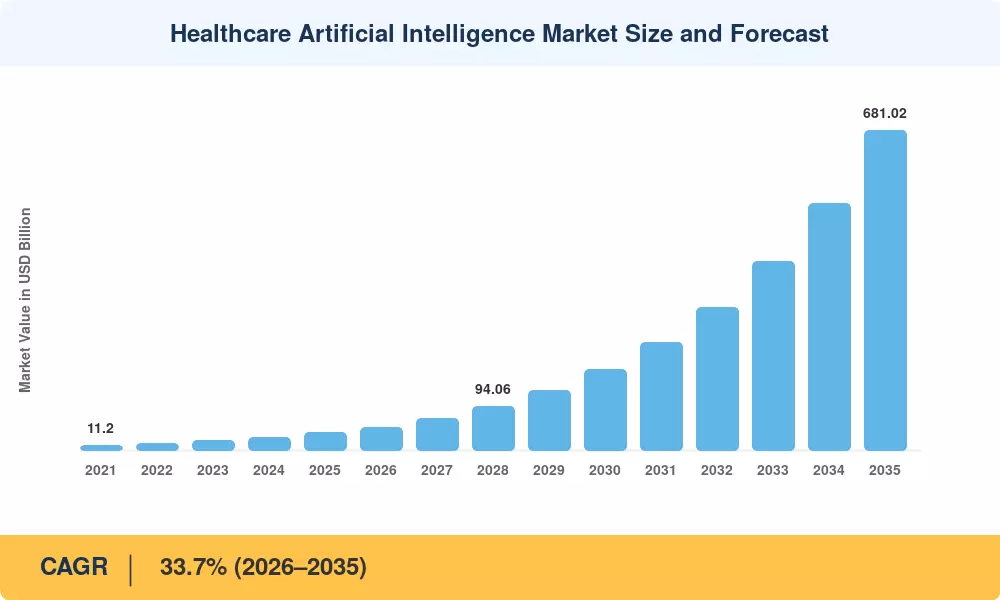
AI in Healthcare Market to Surge from USD 37.33 Bn in 2025 to USD 681.02 Bn by 2035—Growing Need for Personalized Medicine, Increased Use of AI Diagnostic Tools
NY, CA, UNITED STATES, August 26, 2026 /EINPresswire.com/ — As per Market Research Future, the global AI in Healthcare Market size is projected to reach USD 681.02 Billion by 2035 from USD 37.33 Billion in 2025, at a CAGR of 33.7% during the forecast period 2026–2035.
The extraordinary 33.7% CAGR—anchored by a fundamental technological shift in care delivery—is propelled by three converging forces: the growing need for personalized medicine and precision healthcare, which leverages AI to analyze vast datasets and tailor treatments to individual patients; the increased use of AI diagnostic tools, particularly in medical imaging, which is revolutionizing diagnostics by enhancing accuracy and automating workflows; and strong governmental support for healthcare digitalization through strategic initiatives, regulatory frameworks, and funding, which are creating a robust environment for AI adoption and innovation.
Global technology leaders and healthcare organizations are amplifying this momentum. The integration of AI across various systems in the healthcare sector is revolutionizing diagnostics, clinical workflows, and patient management. Predictive analytics, robotic surgery, medical imaging, drug discovery, and a plethora of other applications keep expanding use cases. In telemedicine, remote patient monitoring, and mental healthcare, the use of AI is growing rapidly. Investments in AI startups also contribute to market expansion, alongside the development of machine learning and data analytics, creating more AI tools for healthcare.
Request A Free Sample:
https://www.marketresearchfuture.com/sample_request/5681
Key Market Trends & Growth Drivers
The AI Revolution in Medical Imaging and Diagnostics
The integration of AI in diagnostic imaging is a primary driver, enhancing the accuracy and efficiency of medical imaging. AI algorithms analyze complex imaging data, enabling faster and more precise diagnosis of conditions such as cancer, cardiovascular diseases, and neurological disorders. The Medical Imaging segment dominated in 2024 with a valuation of USD 2.8 Billion and is projected to reach USD 36.0 Billion by 2035, driven by enhanced diagnostic accuracy and imaging automation.
The Rise of Personalized Medicine
AI is playing a crucial role in advancing personalized medicine by enabling the analysis of large datasets to identify patterns and predict individual responses to treatments. Machine Learning remains the most utilized technology, enabling predictive diagnostics and operational optimization. The expansion is also due to the growing need for personalized medicine and the increased use of AI diagnostic tools.
AI-Powered Virtual Health Assistants and Operational Efficiency
The adoption of AI-powered virtual health assistants is on the rise, providing patients with 24/7 access to healthcare information and support. These digital assistants leverage natural language processing (NLP) to offer personalized health advice, schedule appointments, and manage chronic conditions. Hospitals represent the largest end-use segment, utilizing AI for patient care management, diagnostics, and workflow automation to reduce administrative burdens.
Global Policy and Regulatory Support
Governments and regulatory bodies worldwide are playing a pivotal role in accelerating AI adoption in healthcare. The North American region accounted for the largest market share in 2024, valued at USD 4.15 Billion, and is projected to reach USD 53.0 Billion by 2035, supported by a robust healthcare infrastructure and strong AI adoption. Europe follows closely, expected to grow from USD 2.7 Billion in 2024 to USD 34.5 Billion by 2035 due to regulatory support for AI in clinical applications. The Asia-Pacific region is anticipated to experience the fastest growth, expanding from USD 1.85 Billion in 2024 to USD 18.0 Billion by 2035, fueled by rising healthcare digitization and investments in AI-driven solutions.
Ask for Customization:
https://www.marketresearchfuture.com/ask_for_customize/5681
Market Segment Insights
BY APPLICATION
Medical Imaging: Dominant segment in 2024, valued at USD 2.8 Billion and projected to reach USD 36.0 Billion by 2035, driven by enhanced diagnostic accuracy and imaging automation.
Predictive Analytics: Significant segment using AI to forecast patient outcomes, disease progression, and hospital resource needs.
Robotic Surgery: Growing segment where AI enhances the precision and control of surgical robots.
Drug Discovery & Development: AI is transforming this field by identifying drug candidates, predicting their efficacy, and optimizing clinical trial designs.
Virtual Health Assistants: AI-powered chatbots and assistants providing patient engagement and chronic disease management.
BY TECHNOLOGY
Machine Learning (ML): Remains the most utilized technology, enabling predictive diagnostics and operational optimization.
Deep Learning (DL): A subset of ML, enabling the processing of vast amounts of unstructured healthcare data, such as electronic health records (EHRs), medical imaging, and genomic datasets.
Natural Language Processing (NLP): Crucial for analyzing clinical documentation, powering virtual assistants, and extracting insights from unstructured text.
Computer Vision: Key technology behind AI applications in medical imaging, enabling automated image analysis and detection.
BY END USER
Hospitals: Represents the largest end-use segment, utilizing AI for patient care management, diagnostics, and workflow automation.
Pharmaceutical Companies: Leveraging AI for drug discovery and clinical trial acceleration.
Research Institutions & Diagnostic Centers: Utilizing AI for advanced research and precision diagnostics.
Read Detailed Insights:
https://www.marketresearchfuture.com/reports/healthcare-artificial-intelligence-market-5681
Regional Outlook
North America — Market Leader
North America held the largest market share in 2024, valued at USD 4.15 Billion, and is projected to reach USD 53.0 Billion by 2035. This dominance is supported by a robust healthcare infrastructure, strong AI adoption, and significant investments in AI research and development from major technology companies. The region benefits from supportive government initiatives, increasing healthcare data availability, and the presence of key industry players.
Europe — Significant Growth and Regulatory Momentum
Europe is the second-largest market, expected to grow from USD 2.7 Billion in 2024 to USD 34.5 Billion by 2035. The region’s growth is driven by regulatory support for AI in clinical applications and strategic investments in AI-driven healthcare transformation.
Asia-Pacific — The Fastest-Growing Region
The Asia-Pacific region is anticipated to experience the fastest growth, expanding from USD 1.85 Billion in 2024 to USD 18.0 Billion by 2035. This rapid expansion is fueled by rising healthcare digitization, large patient populations, increasing investments in AI startups, and strong government support for AI innovation.
Competitive Landscape
The Healthcare AI Market is competitive and fragmented, with a mix of established tech giants, healthcare conglomerates, and innovative startups. Major players are constantly taking up strategic initiatives like product launches, partnerships, acquisitions, and regional expansions to enhance their portfolios.
KEY COMPANIES:
Amazon
IBM
NVIDIA
Microsoft
Philips
GE Healthcare
Google
Cerner
Epic Systems
Cognizant
Medtronic
Optum
Siemens Healthineers
Future Outlook: 2026–2035
The AI in Healthcare Market is projected to grow at an exceptional CAGR of 33.7%, reaching USD 681.02 Billion by 2035. The future of healthcare will be increasingly defined by AI, with new opportunities emerging across the value chain.
New opportunities lie in:
Development of AI-driven diagnostic tools for early disease detection: Expanding beyond imaging into areas like genomics, pathology, and wearable device data for proactive health management.
Integration of AI in telemedicine platforms for enhanced patient engagement: Creating more personalized and efficient virtual care experiences, improving remote monitoring and chronic disease management.
Creation of predictive analytics solutions for hospital resource management: Helping healthcare systems optimize operations, predict patient surges, and manage staff and bed capacity more effectively.
By 2035, the AI in Healthcare Market is expected to be a cornerstone of healthcare innovation and efficiency, fundamentally transforming how care is delivered, managed, and experienced.
More Related Research Insights:
https://www.marketresearchfuture.com/reports/telemedicine-market-2216
https://www.marketresearchfuture.com/reports/wound-dressing-market-21740
https://www.marketresearchfuture.com/reports/biosimilars-market-1329
https://www.marketresearchfuture.com/reports/nanomedicine-market-10832
https://www.marketresearchfuture.com/reports/healthcare-artificial-intelligence-market-5681
https://www.marketresearchfuture.com/reports/intraocular-lens-market-7264
https://www.marketresearchfuture.com/reports/analytical-instrumentation-market-21857
https://www.marketresearchfuture.com/reports/cleanroom-technology-market-2169
https://www.marketresearchfuture.com/reports/sports-medicine-market-3503
https://www.marketresearchfuture.com/reports/hemostats-market-6413
Market Research Future
Market Research Future
+1 855-661-4441
email us here
Legal Disclaimer:
EIN Presswire provides this news content “as is” without warranty of any kind. We do not accept any responsibility or liability
for the accuracy, content, images, videos, licenses, completeness, legality, or reliability of the information contained in this
article. If you have any complaints or copyright issues related to this article, kindly contact the author above.

Media gallery